
Cedar Hill City Directory Collections
Cedar Hill has no verified, continuous run of locally published volumes in the research record. Instead, a historical clue, regional Dallas volumes, library databases, and newspapers create a useful shelf. Cedar Hill Museum history identifies an 1892 directory, while the Texas State Library and Archives Commission, often called TSLAC, holds long Dallas runs that may include Cedar Hill people or Dallas-area routes. Inclusion is a question to test in each volume, not an assumption. The library's genealogy resources add searchable databases and local newspaper context.
| Collection | Years | Where Held | Access |
|---|---|---|---|
| Cedar Hill local directory reference | 1892 | Cedar Hill Museum and local-history inquiry | History page identifies it; an individual scan was not located. |
| Dallas directory volumes | 1875; 1878-79; 1880-82; 1883-87; 1888-90; 1891-99; selected later runs through 1991 | TSLAC holdings | Print and microform research is on-site; check each volume for Cedar Hill coverage. |
| U.S. City Directories and related databases | 1822-1995 collection span | Ancestry Library at Traphene Hickman Library; HeritageQuest through library systems | Searchable images or indexes only when a title is included. |
| Cedar Hill Chronicle | 1965-1981 | UNT Portal to Texas History | Free digitized issues with full-text and metadata search. |
A directory title is a dated snapshot, not a complete roll of everyone in town. There is also no verified Cedar Hill-specific reverse or criss-cross run, so an address-to-occupant claim needs a volume in hand or a librarian's confirmation. Nearby Ennis, Cleburne, and Hillsboro titles at TSLAC can help with regional movement, but are not proof of Cedar Hill coverage.
Note: A regional title in the holdings list does not establish Cedar Hill coverage until the volume's own geographic scope is checked.
The 1892 Cedar Hill Directory Lead
The museum's local chronology preserves a valuable fact about the 1892 Cedar Hill volume even though it does not reproduce an individual entry. It reports two druggists, two blacksmiths, two confectioners, and one combined confectioner and barber. Those counts show that a directory existed and describe its business snapshot. They do not name residents, prove that the list was complete, or identify a publisher, page number, or scan. Use the lead to frame a question for the museum, library, or TSLAC rather than turning it into a list of people.
The museum history source is illustrated below. The Cedar Hill local-volume clue is best treated as a finding aid: preserve the year and occupation counts, then ask whether staff know the volume's location, an image, or related local papers.
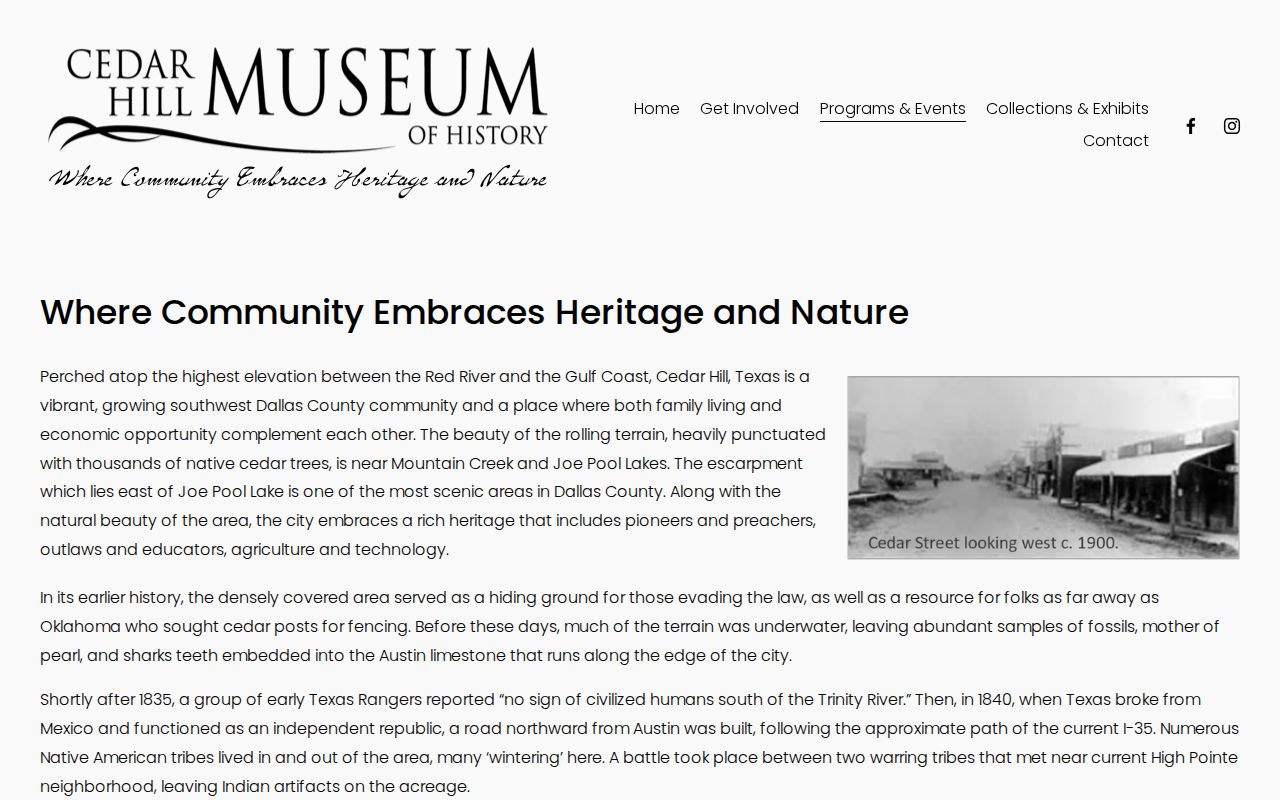
The museum source also helps normalize historical place references. Cedar Hill's 1871 town-square plat and later railroad-era growth can explain why a family appears under an older route or town description instead of a modern street label.
Cedar Hill in Dallas Directory Runs
TSLAC's holdings list identifies Dallas directories for 1875; 1878-79; 1880-82; 1883-87; 1888-90 on film; 1891-99; 1900-01; 1901 on film; 1907; 1910; 1914; 1917; 1919-24; 1927-29; 1932-39; 1941-49; most annual years from 1950 through 1979; and selected 1981-91 titles. Cedar Hill was not automatically included in every Dallas directory. Search a surname, initials, spouse name, and old address, then inspect the title page and geographic coverage before attaching it to a Cedar Hill household.
The TSLAC city-directory guide explains that Austin print and microform holdings are on-site. Staff do not search, transcribe, or scan an entire result by telephone or email. The guide points researchers to digitized routes such as UNT, as well as Ancestry, HeritageQuest, WorldCat, the Library of Congress guide, and the UT Briscoe Center. That access rule makes a precise request more useful: give the surname, likely year, and possible street before visiting or contacting a local library.
TSLAC's city-directory access guide is shown here. It documents the on-site research path instead of promising that every historical volume is freely digitized.
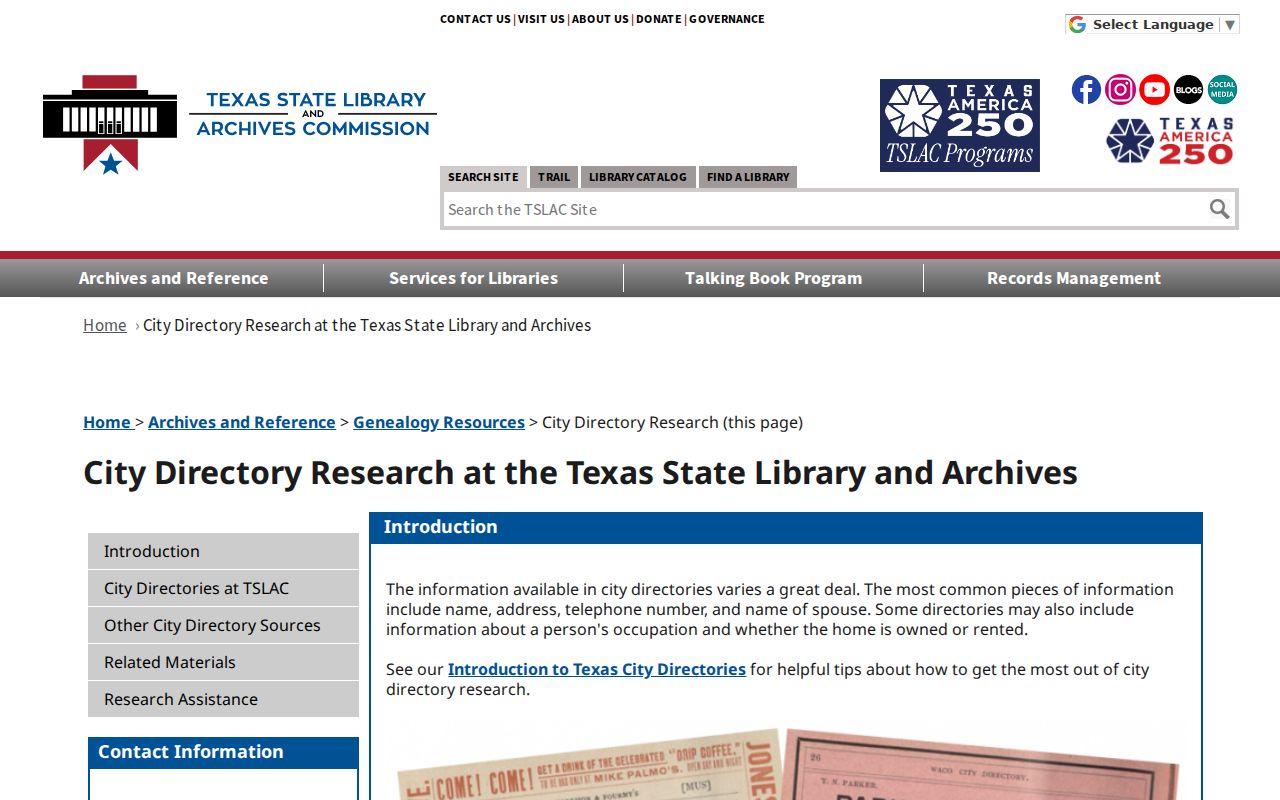
For Cedar Hill research, a Dallas listing can be a lead that needs confirmation through an address, deed, census, or newspaper notice. A person listed in a Dallas volume may have used a business address, received mail, or used a broader regional designation.
Cedar Hill Library Directory Access
Traphene Hickman Library's genealogy page joins the city-directory search with other local history tools. It lists Ancestry Library Edition for use inside the library, FamilySearch links, TexShare Digital Sanborn Maps, and four local newspaper runs: Weekly Chronicle from 1955-56, Cedar Hill Chronicle from 1965-81, Cedar Hill Citizen from 1971-74, and Cedar Hill Today from 1999-2009. Those are different source types. A newspaper can place a name in a community event, while a directory image may place a person or business at an address.
The library's UNT partner information lists a reference phone of 972-291-7323, extension 1300, and library@cedarhilltx.com. It reports a 24-hour Ask a Librarian response, public computers that do not require a card, free TexShare cards, printing at 20 cents black-and-white or 50 cents color, and free fax or scanning up to 200 pages a day. These details make the library a practical access point when a database image, an old paper, or a map needs closer review.
The genealogy resource shown below is the starting point for the local library route. It is especially useful when a Cedar Hill directory search needs a companion newspaper, map, or library-only database.
FamilySearch and local newspapers can supply name variants, relatives, churches, schools, and organizations that make a directory search more precise. They should not be used to fill in an address that the source does not state.
Note: Library database access and service details can change, so confirm current conditions with Traphene Hickman Library before visiting.
Reading a Cedar Hill City Directory Entry
An actual directory entry must be read as its own publisher printed it. Common fields may include a name, address, telephone number, spouse in parentheses, occupation, organization or company, owner or renter mark, widow notation, page, and nearby entries. Not every directory has each field, and abbreviations change by title. For the unscanned 1892 Cedar Hill reference, only occupation counts are documented, so none of these fields can be supplied from that lead.
| Name | Record the spelling, initials, and surname variant exactly as printed. |
|---|---|
| Address | Copy the house number and street, then keep it separate from a later mailing or parcel address. |
| Spouse or relative clue | Parentheses and widow notation can distinguish people with the same name. |
| Occupation or organization | Use it as a search term for newspapers and records, not as proof of identity by itself. |
| Owner or renter mark | Read the volume's key first; the mark is not a deed or proof of continuous occupancy. |
- Criss-cross directory
- An address-ordered directory that can connect a street number to an occupant clue. No Cedar Hill-specific run was verified.
- Householder index
- An index organized around the household, often helpful where several people share a surname or address.
- Abbreviation key
- The publisher's explanation of symbols and shortened terms, usually near the front of the volume. Photograph or transcribe it before interpreting entries.
When the entry is unclear, save the page image, title page, and abbreviation key together. A modern name or street spelling can then be tested without silently altering the historical record.
Cedar Hill Chronicle Directory Companion
The UNT Portal to Texas History collection is the strongest free local name layer identified for Cedar Hill. Its Cedar Hill Chronicle title page has 773 digitized issues and 10,086 pages across 17 years, from May 20, 1965 through December 31, 1981. Full-text, metadata, title, subject, creator, and name searches make it useful for testing a person, business, street, school, church, organization, or obituary term found in a directory volume.
The Chronicle collection is pictured below. A newspaper notice can support a date range or an address clue, but it is not an annual directory and should not replace the directory's own entry.
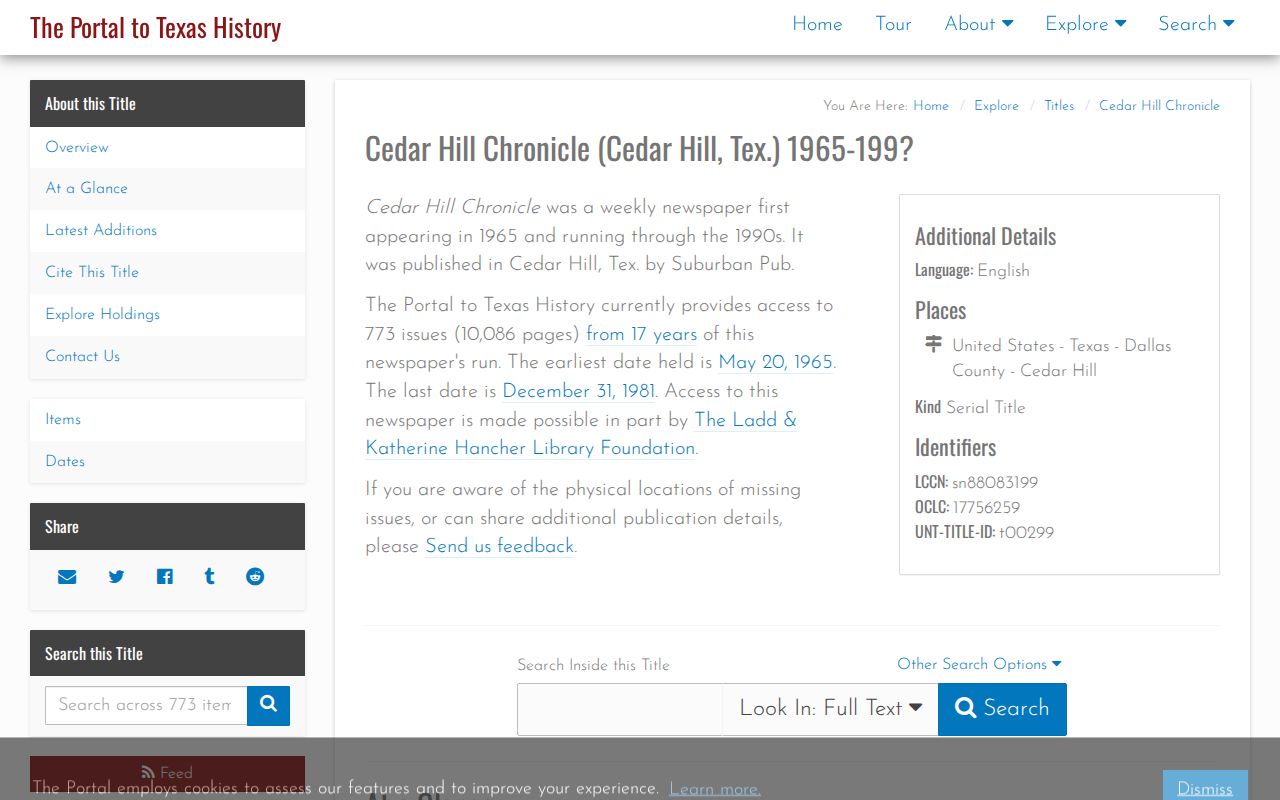
The numbers matter because a full-text search can reveal a spelling a printed index misses. Try a surname with a street, school, church, business, or obituary term, then inspect the issue image and date rather than relying only on a search snippet.
Cedar Hill Directory Address Changes
Historical Cedar Hill research needs more than a directory year. The official local chronology connects settlement around 1846, an 1856 tornado, the 1871 town-square plat, an 1881 railroad arrival, incorporation in 1938, and home-rule status in 1975. County organization and city incorporation are different clocks. A directory, deed, census, or newspaper might therefore use a rural route, county precinct, town name, railroad description, or later city address for the same broad area.
- 1846: Dallas County organization and Cedar Hill settlement context begin the county-record timeline.
- 1871: The town-square plat provides an address-normalization anchor for older descriptions.
- 1881: Railroad arrival adds another likely term for newspaper and directory searching.
- 1938: Cedar Hill incorporated as a city.
- 1975: Cedar Hill became a home-rule city.
Retain the historic description as printed, then compare it with a current parcel or map. Do not declare that a county fire destroyed a specific Cedar Hill directory or deed series: the research located Dallas County's 1848 courthouse-fire context, not a record-specific Cedar Hill loss.
Note: Historic addresses and names can shift across county, postal, and municipal descriptions, so each directory citation needs its own date and source title.
Trace Cedar Hill City Directories by Household
A household trail starts with one confirmed appearance and moves one source year at a time. Write down the exact name, initials, spouse or relative clue, address, and page before searching the next title. Pair directory years with census snapshots, deeds, appraisal history, obituaries, probate, church records, and newspaper notices. A listing can place someone at an address in a given year; it cannot prove ownership, uninterrupted occupancy, or identity where a name is common.
- Find the earliest confirmed directory or newspaper appearance and save its full citation.
- Search surname, initials, married-name variants, and spouse clues in the next available year, allowing for missing titles.
- Record every printed address and compare the historic wording with the 1871 plat or current GIS only after preserving the original.
- Pair the dated address trail with the census year closest to it, then check a county deed or appraisal record for title questions.
- Use an obituary, probate file, cemetery reference, or later newspaper notice to test a disappearance from the record.
Both county routes matter. Most Cedar Hill records route through Dallas County, while the southern portion of the city reaches Ellis County. A family history search should identify the parcel or event county before using Dallas County Central Records or the Ellis County Clerk. A directory name that needs a current identity check can be tested through the Cedar Hill resident lookup process rather than treated as a final answer.
Cedar Hill Directory Research Fallbacks
When a directory volume is absent, Cedar Hill has a clear fallback chain. Start with Traphene Hickman Library for its genealogy resources, local newspapers, Ancestry Library access, FamilySearch route, and TexShare maps. Ask the Cedar Hill Museum about the 1892 lead and related history material. Then try TSLAC for Dallas-area print and microform directories, UNT for the digitized Chronicle, and Dallas Public Library genealogy holdings for Dallasearch and Dallas County cemetery records. Dallas Central Records and the Ellis County Clerk can test property, probate, or local vital-record questions once the county is known.
No official Cedar Hill cemetery database, complete local obituary index, searchable separate historical-society portal, complete funeral-home archive, or verified local reverse-directory run was located. Those gaps are useful limits. They prevent a plausible story from becoming an unsupported directory claim and point the search back to the named custodians and source images.