
Cedar Hill Resident Lookup Records
No single record proves every fact about a person. The search works best when the record matches the question. An appraisal account identifies the assessed owner and its own address fields. A deed index records parties to a filing. Court and voter systems have different purposes and limits. Texas vital indexes can supply a dated family-history lead, while a certificate has its own access rules. Treat every name match as a starting point, then compare the county, date, address field, and record number.
| Record | What It Confirms | Where | Access |
|---|---|---|---|
| CAD parcel card | Assessed owner, situs, mailing field, legal description, and transfer reference | DCAD for the Dallas side; ECAD routes for the Ellis side | Public appraisal search; it is not title or occupancy proof. |
| Recorded deed or index | Grantor, grantee, instrument, legal description, and recording date | Dallas Official Records or the Ellis County Clerk/LGS route | Online index, counter, or written request; image access varies. |
| Voter status | Individual registration status and defined public identity fields | Texas SOS voter service | Individual status route; protected fields remain confidential. |
| Court index | Party, case number, court, date, and available events or disposition | Dallas, Ellis, TAMES, or re:SearchTX | Public index and copy routes, subject to sealed and restricted files. |
| Vital index or verification | Birth, death, marriage, or divorce lead | Texas DSHS Vital Statistics and county clerks | Indexes and certificates have different opening and eligibility rules. |
If an address is known, check the appraisal district first. If a case number is known, begin with the court that owns that case. A date of death or a relative's name points toward DSHS, an obituary, and probate. Each route can narrow a search without turning one record into proof of residence.
Cedar Hill County Record Routing
Cedar Hill is a two-county city. Most of its municipal area is in Dallas County, while a smaller southern area reaches Ellis County. That county line matters before searching a property account, deed, probate file, voter record, or local vital record. Dallas County work begins with DCAD and the County Clerk's official-records search. An Ellis-side address calls for ECAD or Ellis GIS and the Ellis County Clerk in Waxahachie. A Cedar Hill mailing city alone does not settle the question.
Dallas County says its county record-search links do not require registration. Its official-records portal lets a researcher use quick or advanced terms and date filters. Ellis County links property and court searches through LGS, but the live field lists and exact online cutoff were not available during research. Older Ellis material, image needs, and uncertain portal results should go to the clerk, not be guessed from a Dallas result. The Ellis Clerk also handles probate and local vital functions, with separate county and district court responsibilities.
Note: Keep the parcel county with every result, because a Cedar Hill postal address can lead to the wrong custodian.
Cedar Hill Court Search Details
For a Dallas-side criminal name search, the Dallas criminal search offers last name and optional first and middle name, name type, race, sex, date of birth, number type, and pending-status controls. The case-number view requires a case number and last name. Those fields are useful for sorting a shared surname, but the final check still needs the county, case number, court, and disposition. Dallas County Record Search routes county civil, probate, and misdemeanor matters to the county clerk, and district civil, family, and felony matters to the district clerk.
TAMES Case Search is the statewide appellate layer. It offers court, case number or partial number, civil or criminal mode, filed-date range, style, attorney or bar number, trial-court case number, county, and trial-court controls. The service refreshes nightly. A TAMES result can show a case number, style, parties, filed date, originating court, and available appellate documents. It does not replace the trial-file custodian or supply a certified disposition.
Use the TAMES form as a record-placement tool rather than as a complete local answer.
See the official TAMES court-search form before entering case or party information.
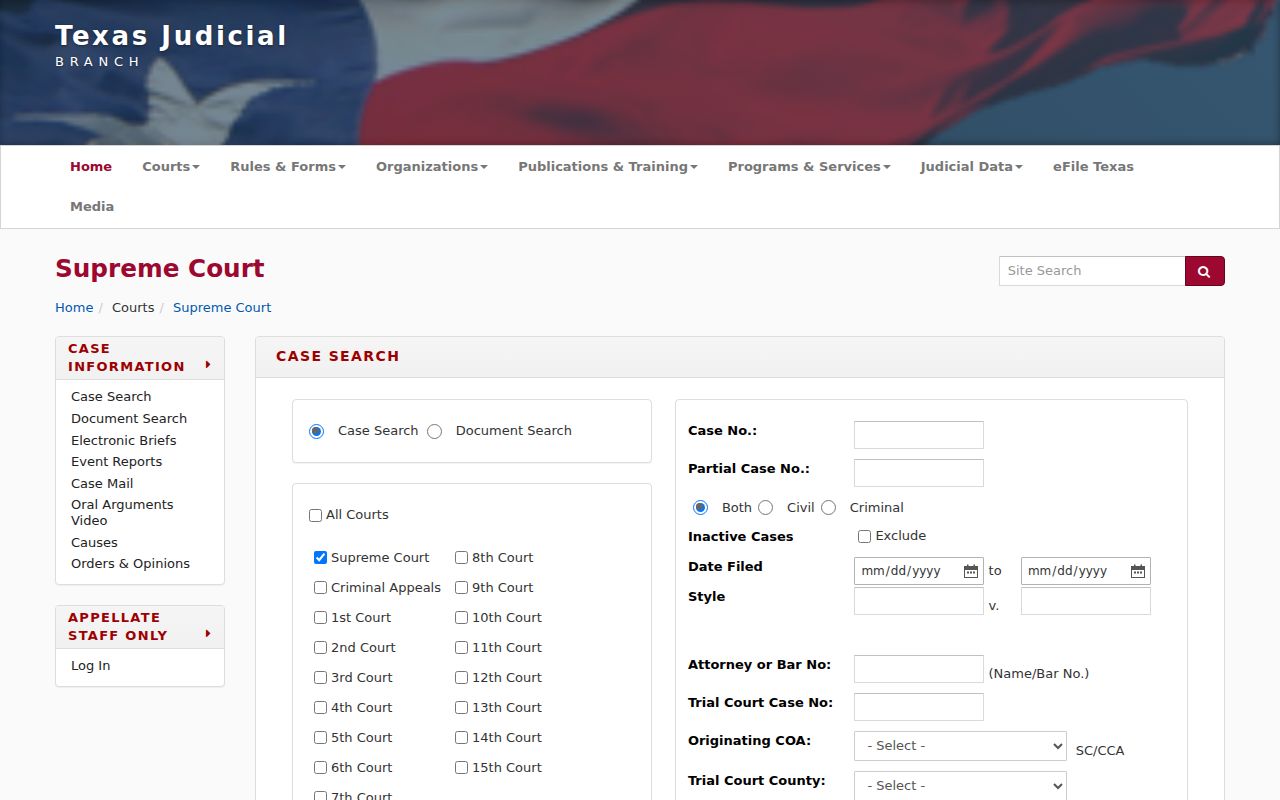
The form's court, style, case-number, county, and date controls help document how a result was narrowed before the local clerk is contacted.
| Result field | Why it matters |
|---|---|
| Indexed party or case style | Identifies the name as recorded, not necessarily the person intended. |
| Case and trial-court number | Lets the correct clerk find the underlying file. |
| Court and originating county | Separates Dallas, Ellis, and appellate routing. |
| Filed and event dates | Places a record in a usable chronology. |
| Document or event link | May point to available appellate material; restrictions still apply. |
When an online result stops at an index, use the clerk that keeps the file. Dallas court users can ask at the George L. Allen Courts Building or Frank Crowley counters for public terminals, docket printouts, certified copies, or archived-file retrieval. Ellis County matters route to the County Clerk or District Clerk in Waxahachie. A written request should identify the party, case number, court, date range, and document sought, while court-specific confidentiality still controls what can be released.
Cedar Hill Municipal Court Path
The Cedar Hill Municipal Court page is a city workflow hub. It publishes links for payment, warrant lookup, docket calendar, forms, juror questionnaire, resources, and juvenile information. The court lists 285 Uptown Boulevard, 469-272-2930, and weekday hours of 8:00 a.m. to 5:00 p.m. The research did not locate a documented public general name-search form or a field-by-field municipal docket inventory. Use the warrant and docket links for their stated functions, then call the court for a case-specific route.
The official Municipal Court page shows the payment, warrant, docket, and form paths available from the city.
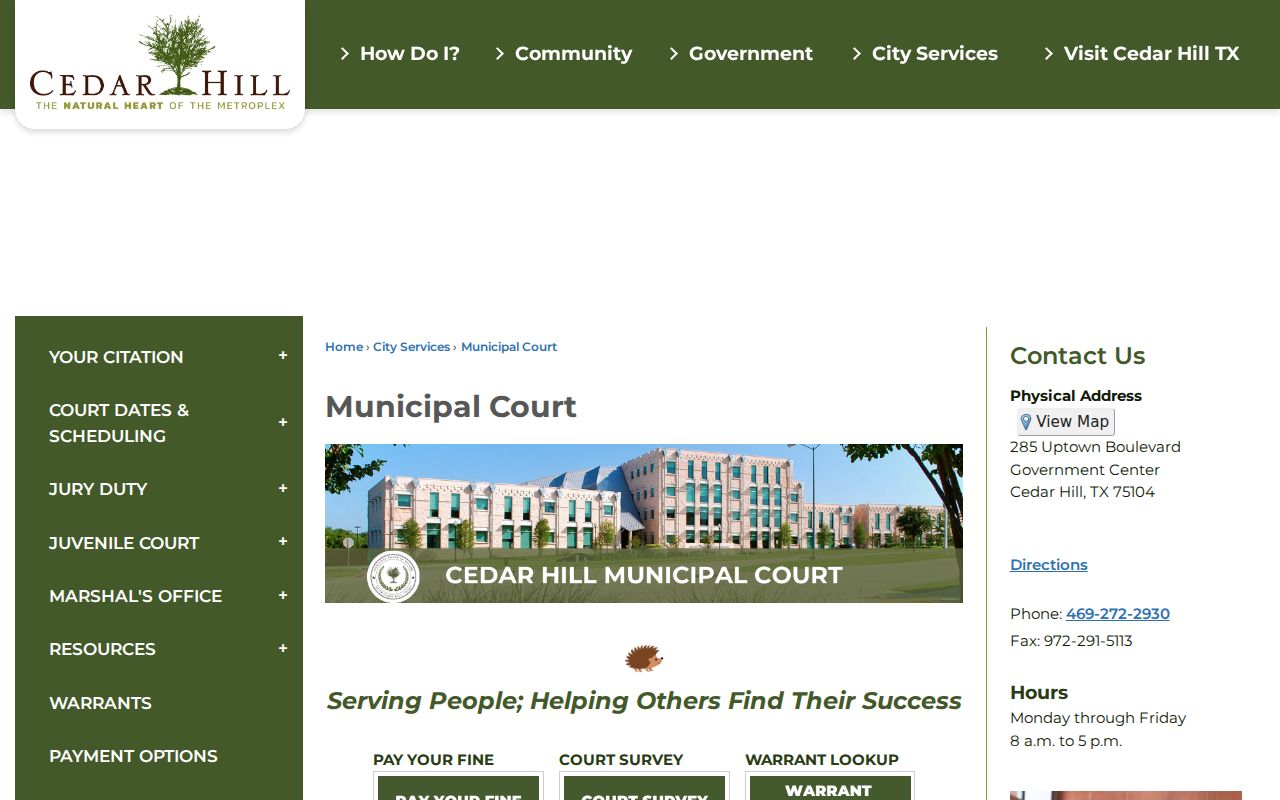
For a docket or file that the public links do not expose, ask the court or City Secretary for an existing non-exempt record and provide the case number, name, and date range.
Cedar Hill Vital Record Openings
Texas DSHS Vital Statistics issues statewide birth and death certificates and verifications, plus marriage and divorce verifications. Under Texas Government Code §552.115, birth records and their indexes become public at 75 years, and death records and their indexes at 25 years. An unidentified death record opens after one year. Those periods do not make a recent certificate available to any curious requester. Recent certificates require an immediate-family or other qualified applicant under DSHS or local-registrar rules.
DSHS offers online, mail, and in-person channels. Most online orders are stated to take 20 to 25 business days. Mail applications need an ID copy, and a certificate application uses a notarized signature while a verification follows a different path. DSHS says its digital birth index begins in 1925 and its digital death index in 1965; earlier microfiche begins in 1903 with a fee quote. An index may give surname, given names or initials, event date, county, and sex. It is a lead, not a certified fact.
For an Ellis-side event, the county clerk states that births reach back to 1850 and that deaths are held when they occurred in Ellis County. Dallas-side events route to Dallas County or DSHS. A divorce verification is not the same thing as the court decree, which belongs with the court clerk.
Note: Save the source and event date, then request a certified copy only through the eligible custodian route.
Cedar Hill Identity Record Checks
A reliable name check tests the same person across independent sources. Start with facts that should agree, such as an address, a middle initial, a date, a county, a business role, or a legal description. Do not merge people only because their first and last names match. Mailing address, situs address, owner percentage, and a court party name are different fields with different meanings.
- Search DCAD or the Ellis-side appraisal route and record the account number, situs, mailing field, legal description, and transfer reference separately.
- Check the county deed index using the owner as a grantee or the legal description. Keep the instrument number and recording date.
- Use the correct court index for name variants, then compare the court, case number, county, and disposition with the property trail.
- Use voter status only for permitted individual confirmation. A nonmatch can reflect a name variant, county mismatch, move, inactive status, or suppression.
- Preserve the search date and ask the custodian to correct an indexing, appraisal, court, or registrar error through its own process.
- Docket
- A court's running case record, often listing case number, parties, filings, events, and dates. A public docket does not guarantee that every document is open.
- Index and image
- An index lists searchable record details. An image is the document scan, which may have separate access, price, or redaction rules.
- Certified copy
- A copy issued or authenticated by the records custodian for official use. It is different from a search result or an informal image.
Cedar Hill Heir Search Routes
For family-history or estate questions, build chronology before drawing a relationship conclusion. The Cedar Hill Library lists genealogy resources, local newspapers, on-site Ancestry Library Edition, FamilySearch, and TexShare maps. The digitized Cedar Hill Chronicle covers 1965 through 1981 and can add obituary details, addresses, and community notices. A known death date can lead from an obituary to the appropriate Dallas or Ellis probate venue, where public filings may identify a representative or heir.
Keep the death source, probate county, filing date, and case number together. Texas vital indexes can support the timeline, but they are not proof of kinship. The same method helps check an older address: a newspaper notice, appraisal history, recorded deed, and probate file each answer a different part of the story. For a broader historical address trail, the Cedar Hill city directory route holds the local-library and directory context.
Note: When the record trail ends at a restricted certificate or sealed file, stop and use the custodian's eligibility process.
Cedar Hill Record Privacy Boundaries
The Texas Public Information Act allows requests for existing non-exempt records. It does not require a city or county to create a new person list, answer an open-ended research question, or disclose protected material. A precise request names the record set, date range, address, parcel, report number, or case number and asks for non-exempt portions with redactions. Cedar Hill accepts written city requests through its open-records channels, while court, appraisal, registrar, and clerk records should go to the actual custodian.
Texas keeps voter phone, Social Security, and driver-license or state-ID data confidential. The Attorney General's Address Confidentiality Program gives eligible participants a substitute mailing address and mail forwarding. Protected voter records, ACP addresses, restricted vital records, juvenile or sealed cases, motor-vehicle information, and redacted identifiers are not gaps to work around. A historic mailing field is not permission to reconstruct a protected current address.
Lawful use. Use Cedar Hill records for personal, lawful research, family history, estate questions, or verifying an official record. Do not use a name, address, map, or record trail to stalk, harass, intimidate, or harm anyone.